


 English
  中文简体
中文简体 


What Is a Heavy Duty Trailer and When Do You Need One?
A Heavy Duty Trailer is a towed or self-propelled transport platform engineered to carry loads that exceed the capacity of standard commercial freight trailers, typically defined as payloads above 40 tonnes, with specialized configurations reaching tens of thousands of tonnes for the most demanding industrial transport projects. Heavy Duty Trailers are the essential enabler of large-scale infrastructure construction, oil and gas project execution, power generation installation, shipyard operations, bridge replacement, and mining equipment relocation across every major industrial economy.
The three fundamental categories of trailers used in heavy transport are: conventional towed trailers (pulled by a prime mover at fixed coupling points), hydraulic platform trailers (with individually controlled hydraulic suspension axles that level the load regardless of road surface), and self propelled modular transporters (SPMT), which integrate their own power and steering into a modular platform that can operate independently of an external tractor. Each type serves different load characteristics, site access conditions, and operational requirements, and choosing incorrectly between them results in either unsafe transport or significant overspend on capacity not needed for the task.
For buyers, project managers, and logistics engineers in the Middle East and globally, understanding the specific performance parameters of hydraulic axle line trailers such as the KTG-3, KTG-4, KTG-5, and KTG-6 series is essential for correct equipment specification on heavy haulage contracts where load weights, axle loads, and road classifications determine both the legal and practical limits of what can be transported on public and private infrastructure.
What Are the Three Types of Trailers: The Classification Framework for Heavy Transport
Understanding what are the three types of trailers in the context of heavy and specialized transport provides the essential framework for equipment selection. The industry categorization distinguishes trailers primarily by their structural design, suspension system, and whether they require an external prime mover for propulsion.
Type 1: Conventional Heavy Haul Trailers
Conventional Heavy Duty Trailer designs include lowbed (lowboy) trailers, step-frame trailers, and extendable trailers that are towed by a heavy-duty tractor unit at the front. These are the most widely used heavy transport platforms globally because of their lower cost relative to hydraulic and self-propelled alternatives, their compatibility with standard tractor units, and their availability from a large global manufacturing base.
Conventional lowbed trailers are available in axle configurations from 2 to 10 axle lines, with payload ratings from 50 tonnes to over 200 tonnes depending on axle count, axle spacing, and structural beam design. The maximum legal axle load in most countries ranges from 8 to 13 tonnes per axle for standard trailers, meaning a 4-axle lowbed trailer with 4 tonnes per axle deck load distributes weight across 8 axle points and can achieve a total payload of approximately 32 to 52 tonnes depending on national regulations. For heavier loads, additional axle lines are added to increase the number of axle contact points and reduce load per axle to legally permissible levels.
Type 2: Hydraulic Platform Trailers with Individually Controlled Axles
Hydraulic platform trailers, also known as hydraulic axle line trailers or SPMT-type platforms when equipped with steering but not propulsion, use individually hydraulically actuated suspension cylinders at each axle position. The hydraulic suspension serves two critical functions simultaneously: it actively levels the cargo platform regardless of road surface irregularities, and it allows the operator to lower the entire deck to facilitate loading and unloading without external lifting equipment.
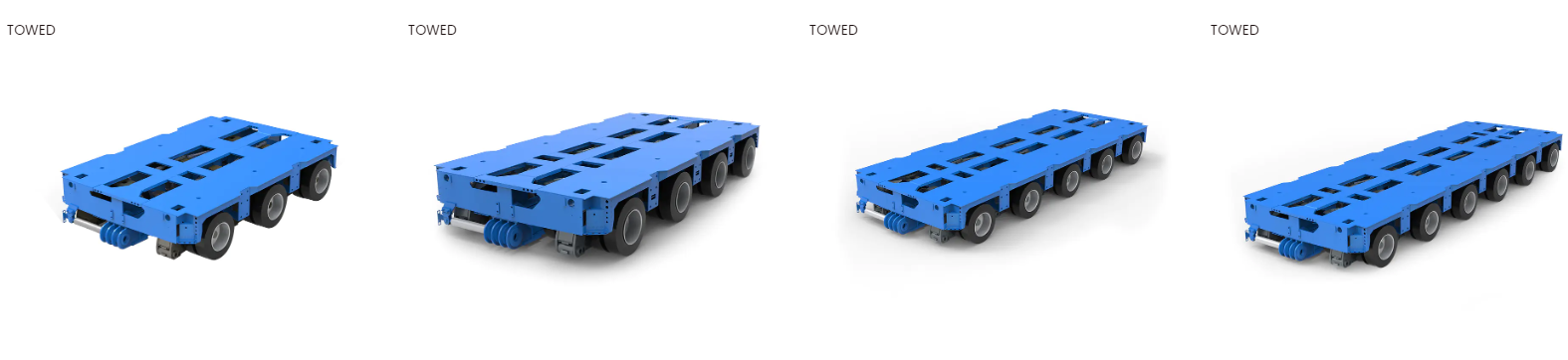
The KTG series hydraulic axle line trailers (KTG-3, KTG-4, KTG-5, KTG-6) represent a purpose-engineered product line within this category, offering 3 to 6 axle lines in a standardized modular format that allows multiple units to be coupled side by side or in tandem to achieve the specific platform dimensions and axle count required for the cargo at hand. This modularity is the defining commercial advantage of hydraulic platform trailers over fixed-configuration conventional lowbeds for heavy industrial transport contracts where loads vary significantly between moves.
Type 3: Self Propelled Modular Transporter (SPMT)
The self propelled modular transporter is the most technologically advanced and operationally flexible category in heavy transport. An SPMT self propelled modular transporter integrates a hydraulic deck, individual axle steering, and an onboard power unit (either diesel or electric) into a modular platform that can move in any direction, rotate on the spot, and traverse terrain that would be inaccessible to tractor-trailer combinations. The self propelled modular trailer designation emphasizes the trailer's ability to operate without an external prime mover, which is critical in applications such as shipyard dry dock transfers, industrial plant turnarounds, and bridge installations where road access for a tractor unit is impossible.
A modern SPMT self propelled modular transporter can carry payloads from 100 to over 100,000 tonnes when multiple modules are synchronized electronically and loaded in a grid configuration, making the SPMT the only viable transport solution for complete platform modules in offshore oil and gas construction, large refinery reactor vessels, and bridge girder installation in urban environments where all surrounding infrastructure remains in service during the lift and transport operation.
Self Propelled Modular Transporter: How SPMT Technology Works
The self propelled modular transporter combines four engineering systems in a single integrated unit: the structural deck frame, the hydraulic suspension and steering system, the power and drive system, and the electronic control and synchronization system. Each system must function correctly and in coordination with all other systems for the SPMT to operate safely under the extreme loads it is designed to carry.
Structural Deck and Modular Architecture
An spmt self propelled modular transporter deck is constructed from high-strength steel in a grid structure that distributes load across all axle positions simultaneously. The modular design allows individual SPMT units of standard width (typically 2.43 m per module) to be connected side by side to create platforms of 2.43 m, 4.86 m, 7.29 m, or greater width, and connected end to end to create platforms of any practical length. A single SPMT module typically provides 4 to 8 axle lines in the travel direction, and modules are combined to match the footprint and weight of the specific load.
The structural steel used in self propelled modular trailer construction is typically high-yield steel with a minimum yield strength of 690 MPa (100,000 psi), providing the strength-to-weight ratio necessary to carry maximum loads while keeping the deck height as low as possible to minimize the combined height of deck plus cargo for bridge and overhead clearance limitations.
Hydraulic Suspension and Steering System
Each axle position in an SPMT self propelled modular transporter is equipped with an independently controlled hydraulic cylinder that suspends the deck above the axle. The hydraulic system connects all cylinders to a common manifold with individual control valves, enabling:
- Active deck leveling: As the SPMT traverses uneven terrain, individual cylinders extend or retract to maintain the deck in a level orientation, protecting sensitive cargo from tilting, sliding, and structural loading from uneven support. Level tolerance is typically plus or minus 0.5 to 1.0 degree from horizontal.
- Height adjustment: The deck can be lowered to ground level for load transfer and raised to travel height during transport. Vertical travel range is typically 300 to 600 mm depending on the SPMT model.
- 360-degree axle steering: Each axle can be steered independently, enabling the SPMT to travel in any direction, turn on a minimal radius, and execute crab steering (sideways travel) without turning the deck. This is the capability that makes SPMT uniquely suited to confined industrial sites.
Power and Drive System
The power unit of an SPMT self propelled modular transporter is typically a diesel engine (or in newer electric-drive models, a battery or fuel cell power source) that drives hydraulic pumps supplying both the suspension cylinders and the wheel drive motors. Drive motors at each axle wheel position provide propulsion and braking, with the electronic control system managing the torque distribution across all driven wheels to prevent wheel slip under the extreme loads involved.
Modern SPMT self propelled modular transporters achieve travel speeds of 1 to 8 km/h depending on load weight, terrain, and route geometry, which may seem slow in absolute terms but is appropriate given the scale and value of the loads being transported. A 5,000-tonne offshore platform module moving at 3 km/h carries kinetic energy equivalent to a fully loaded freight train at line speed, and the controlled low speeds of SPMT transport are a safety-critical design parameter rather than a performance limitation.
KTG Hydraulic Axle Line Trailers: The Complete Specification Guide
The KTG series hydraulic axle line trailers represent a product family designed for the heavy industrial transport sector, with four standard configurations corresponding to 3, 4, 5, and 6 axle lines per trailer unit. Each KTG configuration offers a different payload capacity, deck length, and axle load distribution profile, making the series applicable to a wide range of heavy haul scenarios from large transformers and pressure vessels to offshore equipment modules and port machinery.
KTG-3 Hydraulic Axles Line Trailer with 3 Axle: Specifications and Applications
The KTG-3 hydraulic axles line trailer with 3 axle is the most compact configuration in the KTG series, providing a platform suitable for loads that fit within a 3-axle footprint and require hydraulic suspension for cargo protection or deck leveling capability that conventional trailers cannot provide.
- Axle configuration: 3 lines of hydraulic axles, with 2 or 4 wheels per axle line depending on configuration, providing 6 to 12 total wheel contact points.
- Payload capacity: Typically 60 to 90 tonnes total platform payload, depending on tyre specification and road surface conditions.
- Deck dimensions: Standard deck width of 2.43 to 3.0 m, deck length matching 3-axle module length.
- Hydraulic suspension travel: 300 to 500 mm vertical adjustment range for loading and transport height optimization.
- Best applications: Transformers, small pressure vessels, industrial machinery, generator sets, and military equipment transport where loads are within the 3-axle capacity range.
KTG-4 Hydraulic Axles Line Trailer with 4 Axle: Specifications and Applications
The KTG-4 hydraulic axles line trailer with 4 axle adds one axle line to the KTG-3 platform, proportionally increasing payload capacity and distributing load across a longer contact zone, which reduces the point loading on sensitive road surfaces and bridge structures.
- Axle configuration: 4 lines of hydraulic axles, providing 8 to 16 total wheel contact points.
- Payload capacity: Typically 80 to 120 tonnes total platform payload for standard road transport configurations.
- Axle load per line: Approximately 20 to 30 tonnes per axle line depending on total payload, within the permissible limits for heavy haul permits in most Middle East jurisdictions.
- Best applications: Medium power transformers (50 to 100 tonne range), petrochemical vessels, construction equipment (large excavators, cranes without boom), and port handling machinery.
- Coupling capability: The KTG-4 can be coupled with additional KTG modules in tandem or side-by-side to create larger platforms for loads exceeding the single-unit capacity.
KTG-5 Hydraulic Axles Line Trailer with 5 Axle: Specifications and Applications
The KTG-5 hydraulic axles line trailer with 5 axle provides the mid-range capacity in the KTG series, offering significant payload increase over the 4-axle configuration while remaining within the operational constraints of most heavy haul route surveys for infrastructure and energy projects in the Middle East and globally.
- Axle configuration: 5 lines of hydraulic axles, providing 10 to 20 wheel contact points.
- Payload capacity: Typically 100 to 160 tonnes total platform payload.
- Total vehicle weight: With prime mover and trailer tare, total gross vehicle combination weight (GCVW) reaches 180 to 250 tonnes, requiring special transport permits and often route strengthening or escort in most jurisdictions.
- Deck leveling precision: Hydraulic control maintains deck level within plus or minus 0.5 degrees across all 5 axle positions, protecting sensitive cargo such as transformers and precision industrial equipment from tilt-induced structural or electrical damage.
- Best applications: Large power transformers (100 to 150 tonne range), heavy reactor vessels, bridge girders, offshore module components, and mining equipment relocation.
KTG-6 Hydraulic Axles Line Trailer with 6 Axle: Specifications and Applications
The KTG-6 hydraulic axles line trailer with 6 axle is the heaviest-duty single-unit configuration in the KTG series, providing the maximum axle count and payload of the range in a standard-format module. The 6-axle configuration is appropriate for the heaviest single-lift loads in the 150 to 200 tonne range that must be transported on road infrastructure without requiring full SPMT self propelled modular transporter capabilities.
- Axle configuration: 6 lines of hydraulic axles, providing 12 to 24 wheel contact points depending on twin-tyre or super single tyre configuration.
- Payload capacity: Typically 150 to 250 tonnes total platform payload for standard configuration.
- Axle load management: The 6-axle configuration allows the hydraulic system to equalize load across all axles, compensating for asymmetric cargo loading that would otherwise cause individual axle overloading in conventional fixed-suspension trailers.
- Multi-unit coupling: Multiple KTG-6 units can be coupled in tandem to create extended platforms for very long loads such as bridge girders, wind turbine towers, and pipeline sections exceeding 50 metres in length.
- Best applications: Extra-large transformers and reactors above 150 tonnes, heavy industrial modules, oil and gas plant components, offshore logistics in port environments, and large civil infrastructure elements.
KTG Series Comparison Table
| Specification | KTG-3 (3 Axle) | KTG-4 (4 Axle) | KTG-5 (5 Axle) | KTG-6 (6 Axle) |
|---|---|---|---|---|
| Axle lines | 3 | 4 | 5 | 6 |
| Typical payload (tonnes) | 60 to 90 | 80 to 120 | 100 to 160 | 150 to 250 |
| Wheel contact points | 6 to 12 | 8 to 16 | 10 to 20 | 12 to 24 |
| Hydraulic suspension travel | 300 to 500 mm | 300 to 500 mm | 300 to 600 mm | 300 to 600 mm |
| Modular coupling | Yes | Yes | Yes | Yes |
| Deck leveling precision | +/- 0.5 to 1.0 deg | +/- 0.5 to 1.0 deg | +/- 0.5 deg | +/- 0.5 deg |
Middle East Heavy Duty Transporter: Market Requirements and Operating Conditions
The Middle East Heavy Duty Transporter market has unique characteristics driven by the scale of the region's energy, petrochemical, and infrastructure development programs. Saudi Arabia, UAE, Qatar, Kuwait, Oman, and Bahrain collectively represent one of the highest concentrations of heavy haulage demand per capita of any region globally, driven by ongoing mega-project construction across refinery expansions, LNG facility developments, power generation upgrades, and urban infrastructure programs of exceptional scale.
Factors That Define Middle East Heavy Haulage Requirements
- Extreme ambient temperatures: Ambient temperatures in the Gulf region regularly exceed 45 degrees Celsius in summer months, which significantly affects hydraulic oil viscosity, tyre heat buildup, and engine cooling requirements for Middle East Heavy Duty Transporter operations. Hydraulic systems for Middle East Heavy Duty Transporter use must be specified with synthetic high-temperature hydraulic oils and oversized cooling systems that maintain operating viscosity within specification at 45 to 50 degree ambient conditions. Standard hydraulic oils rated for European ambient temperatures will thin beyond their effective viscosity range in peak Gulf summer conditions, causing reduced hydraulic pressure and potentially catastrophic loss of load control.
- Sand and dust ingress protection: Windblown sand particles in Gulf desert environments are extremely fine and abrasive, penetrating unsealed bearings, hydraulic connections, and electrical systems at rates that would not be encountered in temperate climate operations. Middle East Heavy Duty Transporter specifications must include IP65 or higher rated electrical enclosures, sealed hydraulic connections, and sealed maintenance-free bearings at all axle pivot points. Unprotected conventional bearing arrangements require frequent replacement intervals measured in months rather than years in high-dust Gulf environments.
- Road quality variation: Middle East heavy haulage routes range from premium multi-lane highways with excellent pavement quality to unpaved industrial access roads, port terminal hardstands, and desert track sections connecting construction sites to the nearest public road. The hydraulic suspension of KTG series trailers and SPMT platforms is particularly valuable in this operating environment because it actively compensates for surface irregularities that would create dangerous dynamic loads on conventional fixed-suspension trailers.
- Large single-lift transport demand: The Middle East's oil and gas sector generates consistent demand for transport of the largest heavy haul cargoes in the world: offshore jacket structures, FPSO modules, refinery reactor vessels exceeding 500 tonnes, and power generation equipment including large gas turbines and their associated transformers. This demand drives the selection of large-format KTG-6 configurations and SPMT platforms for projects where individual lifts exceed 200 tonnes.
- Port-to-site logistics: Many heavy cargoes arriving in the Middle East come through major ports including Jebel Ali (UAE), King Abdul Aziz Port in Dammam (Saudi Arabia), Port of Sohar (Oman), and Hamad Port (Qatar). The heavy haul logistics chain from port discharge to project site often involves both SPMT operations within the port environment (where road access is constrained) and conventional road transport with KTG platform trailers for the road portion of the journey.
Middle East Semi-Trailer: The Standard Commercial Transport Backbone
The Middle East Semi-Trailer market encompasses the full range of standard commercial freight semitrailers from standard flatbeds and curtainsiders through specialized lowbeds and temperature-controlled units that form the backbone of regional logistics infrastructure. While not classified as Heavy Duty Trailer equipment, the Middle East Semi-Trailer segment is operationally linked to heavy haulage because standard semitrailers often handle the pre-positioning of components, accessories, and support equipment for large heavy haulage projects.
The Gulf Cooperation Council (GCC) harmonized vehicle and transport regulations set maximum permissible gross vehicle combination weights (GCVW) at 65 tonnes for standard permitted configurations in most member states, with special permits required for any combination exceeding this limit. This threshold is the commercial boundary between standard Middle East Semi-Trailer operations and heavy haulage operations requiring specialized KTG or SPMT equipment and the corresponding engineering analysis, route surveys, and permit applications.
SPMT vs KTG Hydraulic Trailer: Choosing the Right Equipment for Your Project
The decision between an SPMT self propelled modular transporter and a KTG hydraulic axle line trailer for a specific heavy transport task involves evaluating five key project factors: available road access and route constraints, load weight and geometry, site entry and positioning requirements, transport distance, and total project budget including mobilization costs.
When to Choose an SPMT Self Propelled Modular Transporter
- Confined site access where tractor-trailer combinations cannot maneuver: SPMT units can crab steer, rotate loads in place, and pass through clearances that conventional trailer-prime mover combinations cannot navigate. Shipyard dry dock loading, module positioning on offshore topsides, and placement of equipment in operationally active industrial facilities all typically require SPMT capability.
- Loads above 500 tonnes single lift: While KTG trailers coupled in large configurations can theoretically handle very high gross loads, the operational management of very large multi-unit KTG arrangements with a single prime mover becomes practically complex above approximately 500 tonnes. Above this weight, SPMT platforms with integrated propulsion at each module position provide more controllable load management and more precise positioning capability.
- Transfer between floating and fixed structures (load-in/load-out): The self-leveling capability of SPMT hydraulic suspension combined with self-propulsion makes SPMT the standard tool for load-in and load-out operations between vessels and quayside structures, where tidal variation and vessel motion require continuous deck height adjustment during the transfer process.
When to Choose a KTG Hydraulic Axle Line Trailer
- Road transport over distances above 5 km: SPMT self propelled modular transporters travel at 1 to 8 km/h and are not suited for long-distance road moves. KTG hydraulic axle line trailers pulled by a prime mover can travel at road speeds appropriate for the permit conditions, typically 15 to 40 km/h for heavy haul movements, making them the correct choice for transport between ports, rail terminals, and project sites over meaningful road distances.
- Loads of 60 to 250 tonnes requiring road transport: The KTG-3 through KTG-6 series cover the 60 to 250 tonne single-unit range with appropriate hydraulic suspension and modular expansion capability, at significantly lower equipment mobilization cost than SPMT platforms for road transport applications within this weight range.
- Projects with high transport frequency and moderate single-move weight: For recurring transport of industrial equipment at 80 to 150 tonnes per move (such as regular plant turnaround movements, mining equipment relocations, or recurring power transformer replacements), a KTG-4 or KTG-5 trailer provides the most cost-effective solution because its lower daily operating cost relative to SPMT rental amortizes more favorably over multiple moves.
SPMT vs KTG: Decision Criteria Comparison
| Decision Criterion | SPMT Self Propelled Modular Transporter | KTG Hydraulic Axle Line Trailer |
|---|---|---|
| Maximum practical payload | Theoretically unlimited (100,000+ tonnes multi-module) | Up to 250 tonnes per single unit; higher with tandem coupling |
| Travel speed | 1 to 8 km/h | 15 to 40 km/h (road speed with prime mover) |
| Steering flexibility | Full 360-degree crab, rotation, any direction | Conventional trailer steering; limited maneuvering |
| Road transport suitability | Short distances only; road surface damage risk at low speed | Excellent; designed for public and private road transport |
| Site positioning precision | Millimeter precision in all directions | Moderate; requires external guidance for final positioning |
| Typical daily operating cost | High (specialized crew, fuel, maintenance) | Lower (standard driver, prime mover fuel) |
Route Survey, Permits, and Structural Engineering for Heavy Duty Trailer Transport
Every heavy haulage movement involving a Heavy Duty Trailer above legal gross vehicle weight limits requires a structured pre-transport engineering process covering route survey, permit applications, and in some cases, temporary strengthening of bridges, culverts, and road surfaces along the proposed route. This process is not bureaucratic overhead but a genuine safety and liability management requirement: an overloaded bridge that fails under a 200-tonne load delivers consequences that no transport insurance policy fully covers.
Route Survey Requirements for KTG and SPMT Transport
A route survey for heavy haul transport using KTG or SPMT equipment must document and assess:
- Bridge capacity: Every bridge on the proposed route must be assessed for compatibility with the proposed gross vehicle combination weight and axle load configuration. Original design drawings, current structural condition inspection reports, and traffic loading history are required inputs. For Middle East routes, many bridges were originally designed to European or American highway loading standards from the 1970s and 1980s, and their actual remaining capacity under specific heavy haul vehicle configurations requires independent structural engineering analysis.
- Overhead clearance: All overhead obstructions including power lines, telecommunications cables, bridge soffits, and signage gantries must be identified and their clearance verified against the transport height of the cargo plus trailer deck. For transformers and reactor vessels with heights above 5 metres on deck, overhead electrical lines at 11 kV and 33 kV may require temporary de-energization and physical raising before the transport movement can proceed.
- Road width and turning radius: The swept path of a Heavy Duty Trailer combination during turns must be calculated and physically verified as fitting within available road width, particularly at intersections, roundabouts, and road curves. KTG trailer combinations with hydraulic rear steering (common on KTG-5 and KTG-6 configurations) reduce the swept path by steering the rear axle groups in the opposite direction to the prime mover during turns.
- Pavement condition and bearing capacity: Soft or damaged road surfaces may require temporary steel plate running tracks, ground improvement, or route deviation to avoid permanent pavement damage and to prevent loss of vehicle stability on soft ground. This is particularly relevant for Middle East site access roads through recently graded desert terrain.
Frequently Asked Questions
1. What is a heavy duty trailer and how does it differ from a standard commercial trailer?
A Heavy Duty Trailer is a transport platform engineered specifically for loads exceeding the payload capacity of standard commercial freight trailers, typically above 40 tonnes payload, with specialized structural, suspension, and steering systems for safe transport of oversized, overweight, or structurally sensitive cargo. Standard commercial trailers (flatbeds, curtainsiders, refrigerated units) are designed for loads up to 24 to 28 tonnes payload in most markets, use conventional leaf spring or air suspension, and connect to standard fifth-wheel tractor units. Heavy Duty Trailers use higher-strength steel structures, hydraulic suspension, multi-axle configurations for load distribution, and often require special permits for every transport movement above legal weight limits.
2. What are the three types of trailers used in heavy haulage?
The three types of trailers in heavy haulage are: conventional heavy haul trailers (lowbeds, step-frames, and extendables pulled by a prime mover at fixed coupling points), hydraulic platform trailers (with individually controlled hydraulic suspension axles including the KTG-3, KTG-4, KTG-5, and KTG-6 series), and self propelled modular transporters (SPMT), which integrate their own power, steering, and hydraulic leveling without requiring an external prime mover. Each type addresses different combinations of payload weight, transport distance, site access constraints, and positioning precision requirements.
3. How does a self propelled modular transporter work?
An spmt self propelled modular transporter works by integrating independently controlled hydraulic suspension cylinders at each axle position (which level the deck and transfer load evenly regardless of terrain), individual hydraulic wheel drive motors that provide propulsion and braking, 360-degree axle steering at every axle group enabling movement in any direction, and an electronic synchronization system that coordinates all hydraulic and drive functions across multiple coupled modules. The result is a platform that can carry extremely heavy loads with millimeter positioning precision while protecting sensitive cargo from tilting or shock loading throughout the transport movement.
4. What makes Middle East Heavy Duty Transporter operations different from European or North American heavy haulage?
Middle East Heavy Duty Transporter operations differ from temperate-climate heavy haulage primarily in their extreme ambient temperature requirements (up to 50 degrees Celsius ambient, requiring high-temperature hydraulic oils and enlarged cooling systems), sand and dust ingress protection requirements (IP65 or higher for all electrical and hydraulic components), the exceptional scale of individual cargo weights driven by the Gulf's energy sector project pipeline, and the frequent combination of port-based SPMT operations and road-based KTG trailer transport within a single project logistics chain. Equipment not specifically configured for Gulf conditions will experience premature failures in hydraulic, electrical, and mechanical systems when operated in peak Middle East summer conditions.
5. What is the maximum payload of a KTG-6 hydraulic axle line trailer?
The KTG-6 hydraulic axles line trailer with 6 axle provides a typical maximum payload of 150 to 250 tonnes in standard single-unit configuration, depending on tyre specification, road surface bearing capacity, and the applicable national or regional axle load regulations. When multiple KTG-6 units are coupled in tandem, total payload increases proportionally with the number of units combined. For loads exceeding 500 tonnes, an SPMT self propelled modular transporter configuration is typically more appropriate for both capacity and operational reasons, particularly where precision positioning at the destination is required.
6. Do I need a special permit to operate a KTG hydraulic axle line trailer?
Yes, in virtually all jurisdictions worldwide, any vehicle combination exceeding the standard legal maximum gross vehicle weight (typically 40 to 65 tonnes depending on country) requires a special transport permit before movement on public roads. For KTG trailers in any axle configuration above KTG-3 carrying substantial loads, permits will be required in most markets. The permit process typically requires submission of vehicle specifications, route survey documentation, bridge assessment reports, and a proposed transport schedule, with approval from the relevant highway and transport authority before movement commences. In Middle East jurisdictions, permits are issued by the Ministry of Transport in each respective country.
7. Can a KTG hydraulic trailer be used instead of an SPMT for all heavy haulage jobs?
No, KTG hydraulic axle line trailers cannot replace SPMT self propelled modular transporters for all heavy haulage applications. The primary limitations of KTG trailers compared to SPMT are their requirement for an external prime mover for propulsion (which limits access in confined sites), their conventional trailer steering envelope (which prevents crab steering and in-place rotation), and their lower maximum practical payload for single-lift moves above approximately 500 tonnes. SPMT is specifically required for load-in and load-out operations at ports, confined industrial site positioning, and any application where the transport platform must maneuver in directions or through clearances impossible for a tractor-trailer combination.
8. What is the difference between a self propelled modular transporter and a self propelled modular trailer?
The terms self propelled modular transporter and self propelled modular trailer both refer to essentially the same class of equipment: a modular hydraulic platform with integrated propulsion that can operate without an external prime mover. The term self propelled modular trailer (SPMT) emphasizes the modular nature of the platform and its compatibility with standard trailer coupling and configuration conventions, while self propelled modular transporter emphasizes the complete transport capability of the platform including its propulsion and control systems. In commercial and technical usage the two terms are largely interchangeable, and the acronym SPMT is consistently used for both.
9. How does the KTG-5 compare to the KTG-6 for transformer transport in the Middle East?
For power transformer transport in the Middle East, the choice between the KTG-5 hydraulic axles line trailer with 5 axle and the KTG-6 hydraulic axles line trailer with 6 axle depends on the transformer weight and the axle load limits applicable to the specific transport route. Transformers in the 100 to 150 tonne range are typically within KTG-5 capability, while transformers above 150 tonnes require KTG-6 capacity or tandem-coupled configurations. For the most common large grid transformer weights in Middle East power infrastructure projects, which range from 100 to 250 tonnes, the KTG-5 covers the lighter units and the KTG-6 handles the heaviest units, making both essential parts of a complete Middle East Heavy Duty Transporter fleet for energy sector logistics.
10. What structural steel is used in Heavy Duty Trailers and why does it matter?
Heavy Duty Trailers including the KTG series and SPMT platforms use high-strength structural steel with minimum yield strengths typically ranging from 460 MPa to 690 MPa (compared to 235 MPa to 355 MPa for standard structural steel in conventional trailers). This high-strength steel enables the trailer structure to carry extreme loads within a deck thickness and overall weight that keeps the trailer's own tare weight as low as practically achievable, maximizing the net payload the trailer can carry within any given gross vehicle weight limit. For Middle East operations, the steel specification must also consider the elevated service temperatures, where standard structural steel may experience slight reductions in yield strength at sustained temperatures above 100 degrees Celsius that can occur in high-ambient desert environments when the steel deck is exposed to direct solar radiation without cargo or shading above it.


